Call (502) 922-5047
Historic bungalow house with a flat roof addition and porch in Louisville

Low-Slope Homes

Flat roofs on Highlands bungalows: what owners should know

A Highlands bungalow looks like a pitched-roof house from the street, but the back addition, the porch, or the dormer often hides a flat or low-slope section. Those sections are where the leaks start, and they need different care.

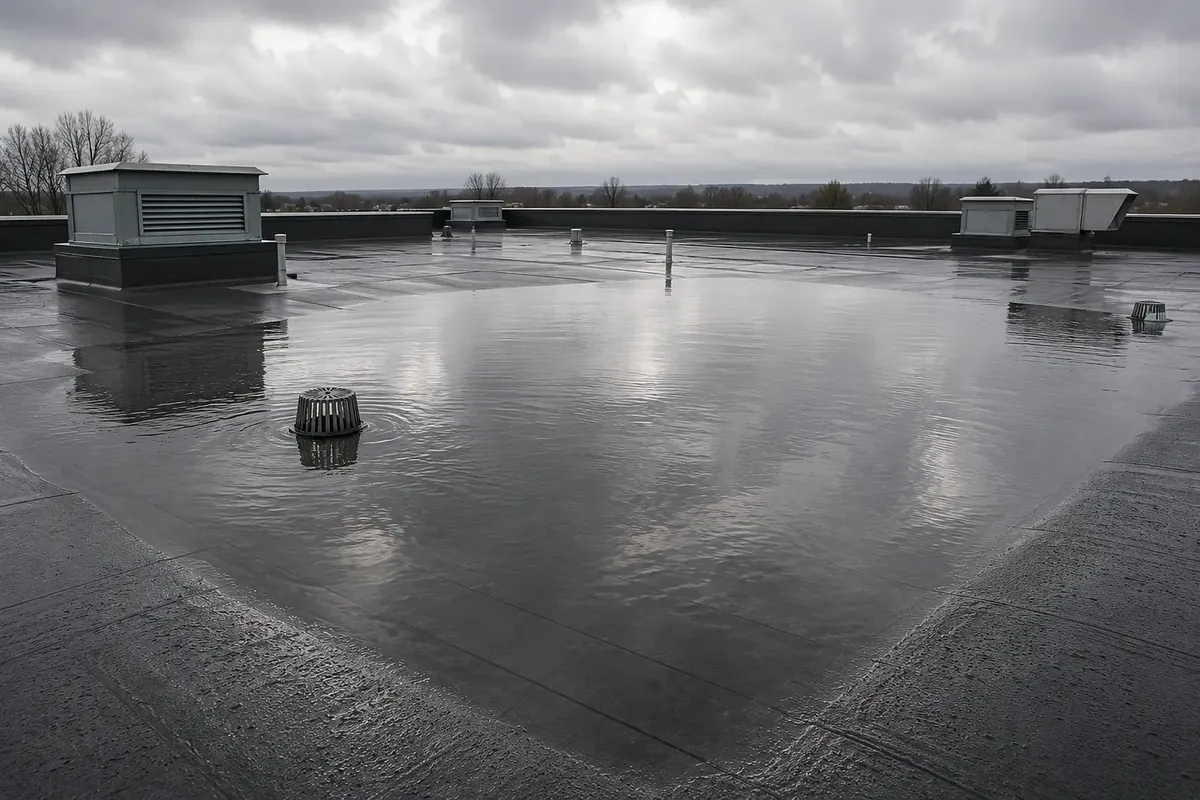
Flat roof membrane with ponding water near a drain
Ponding water after rain is the first sign a flat section is not draining.

Where they hide

The flat sections hide at the back of the house

Highlands bungalows were built in waves from the early 1900s onward, and many gained a back addition, a sleeping porch, or a kitchen extension over the years. Those additions often have a flat or low-slope roof, tucked behind the main pitched roof where the street never sees it. The owner sees the steep front slope and forgets the flat section at the back, until the ceiling stains show up.

A flat roof is not really flat: it is built with a slight fall toward a drain or a scupper, and that fall is what moves the water off. On an old bungalow, the fall can settle over time, and the water starts to pond in the low spots instead of draining. Ponding water wears the membrane down, and every seam that sits under water is a seam that will leak sooner.

The wall where the flat section meets the house is the other weak point. The flashing there has to seal the joint between the low roof and the wall above it, and on an old bungalow that flashing is often the original work, bent and sealed decades ago. When it cracks, water runs behind the wall and shows up inside as a stain far from the roof. Flat and low-slope roofing in Louisville covers the repair and the replacement of these sections.

Materials

What flat roofs on bungalows are made of

Three membranes cover most Highlands flat sections. Each one has its own way of failing, and its own way of being fixed.

Flat roof materials on Highlands bungalows
MaterialHow it worksWhat fails first
Modified bitumenLayered asphalt sheets, torched or stuck downSeams lifting, cracks from sun and age
TPO membraneSingle white sheet, heat-welded seamsSeam failure, punctures from foot traffic
EPDM rubberSingle black rubber sheet, glued seamsShrinkage pulling at edges, seam leaks
Built-up roofingLayers of felt and asphaltBlisters from trapped moisture, surface wear

Scroll sideways to see the full table.

Got a flat section on your Highlands bungalow? Call and get it walked properly.

Call (502) 922-5047
Historic bungalow house exterior with porch and pitched roof in Louisville
The pitched front gets the attention. The flat back section does the leaking.

Drainage

Drainage is the whole job on a flat roof

A pitched roof sheds water by gravity, and a flat roof has to be helped. The drain, the scupper, or the gutter at the low edge is the only way out, and when it clogs with leaves from the Highlands maples, the water has nowhere to go. A single autumn of leaves in the drain can leave a flat section ponding all winter, and the membrane under standing water ages years in a season.

The check is simple and it is a fall job: clear the drain and the scupper, look for ponding two days after rain, and check the seams where the water sits. If water still stands two days after rain, the fall has settled and the section needs a roofer's look. A coating can buy time on a sound membrane, but it cannot fix a drain that does not drain.

Living with one

How to live with a flat section on a bungalow

A flat section is not a defect. It is a different roof that needs a different routine, and the routine is short.

Check the flat section twice a year, in spring and in fall, and after any big storm. Look at the drain first, then at the seams, then at the wall flashing where the flat roof meets the house. Walk it only when it is dry and only if you know where the deck is sound, since a soft spot under a membrane is easy to step through. Most owners are better off asking a roofer to walk it, since the seams and the flashing are read by touch.

Keep foot traffic off it. A flat roof on a bungalow is not a deck, and every step wears the membrane, especially in summer heat. If workmen need access for a chimney or a skylight, ask them to lay boards down first. And keep the trees back: a limb that drops onto a flat membrane punctures it in a way that a pitched shingle roof would shrug off.

People also ask

Owners also ask about flat roofs on bungalows

Short answers on flat sections over Highlands bungalows.

Why does my flat roof hold water after it rains?

The fall toward the drain has settled, or the drain is clogged with leaves, so the water has nowhere to go. A flat roof needs a slight slope to a drain or scupper, and when that slope flattens out, water ponds in the low spots. Clearing the drain helps at once, and a settled fall needs a roofer's look.

Can a flat roof on a bungalow be repaired, or does it need replacing?

It can often be repaired when the membrane is sound and the trouble is local, such as a failed seam or a cracked flashing detail. A replacement comes into the picture when the membrane is worn across the whole section, the seams fail in several places, or the deck below is soft.

How long does a flat roof on a Highlands bungalow last?

A membrane on a bungalow flat roof often lasts about 20 to 30 years, and drainage decides where it lands in that range. A section that drains well and gets its seams checked each year runs longer than one that ponds after every rain. Standing water at the seams is what shortens it most.

Not sure how your flat section is holding up? Call and ask for a look.

Call (502) 922-5047

Frequently asked questions

Flat roofs on bungalows: the questions that matter

Look at the back of the house from the yard, and at the porch and the additions. The flat section hides behind the main pitched roof, so it is easy to miss from the street. A roofer can point it out on a first visit, and the ceiling stains below it are often the first clue.

Failed seams, clogged drains, and cracked wall flashing are the three usual causes. Seams fail where water ponds, drains clog with leaves from the Highlands maples, and the flashing where the flat roof meets the wall cracks with age. All three are found by a close look at the section.

Only when it is dry and only if you know the deck is sound, and even then it is better to let a roofer walk it. A soft spot under a membrane is easy to step through, and foot traffic wears the membrane. If workmen need access, ask them to lay boards down first.

A coating can help when the membrane is sound and the trouble is surface wear or small seam leaks. It cannot fix a membrane that is worn through, seams that fail in several places, or a drain that does not drain. A roofer should read the membrane first and say whether a coating or a replacement fits.

Water sits on a flat roof instead of running off, so every seam and joint spends more time wet. A pitched roof sheds water in minutes, while a flat section can hold it for days. That is why drainage and seam checks matter more on a flat roof, and why a clogged drain is a bigger problem there.

Yes, a little more. A flat section needs its drain cleared in fall, its seams checked in spring, and its wall flashing looked at each year. The routine is short, and it is the difference between a membrane that runs its full life and one that leaks early.

Keep reading

Read next: coatings and historic roofs

If a coating is on your mind, read can a roof coating save your flat roof. For the historic side of Louisville roofing, read slate and tile roofs on Old Louisville Victorians.

Flat roof on your Highlands bungalow?

Call and we will walk the flat section, check the drain and the seams, and tell you plainly what it needs.